

More Than One Way to Make a Mark
- Tom Sloan
- Feb 9
- 2 min read

Why diversifying process keeps creativity — and thinking alive!
There comes a point in creative work when familiarity stops feeling grounding and starts feeling restrictive.
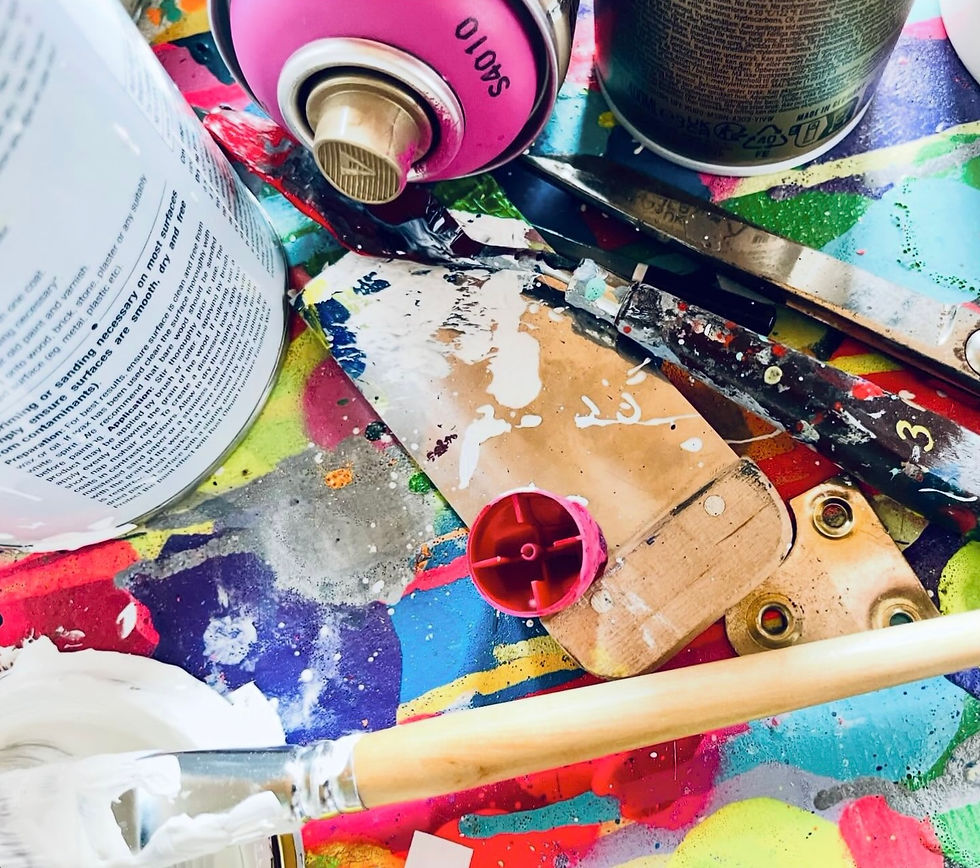
For a long time, acrylics and spray paint have been my main language. They’ve carried ideas clearly and consistently. But recently, I’ve noticed a shift — not a lack of ideas, but an excess of creative energy with nowhere new to go.
That moment is familiar in consultancy work too.
It’s rarely about capability.
It’s usually about conditions.
Excitement needs room to move
Creative energy doesn’t always want refinement. Sometimes it wants movement.
Collage.
Sketching.
Writing.
Photography.
Different materials. Different surfaces. Different speeds.
Each process changes the way thinking behaves. Collage loosens structure. Sketching allows uncertainty. Writing slows decisions down. Photography sharpens attention. Together, they create momentum without pressure.
This is something I see repeatedly when working with individuals and teams. When thinking is forced to stay in one mode for too long, it narrows. When new processes are introduced — even temporarily — clarity often follows.
It’s not about abandoning what works.
It’s about stopping one approach from having to carry everything.

Processes shape thinking
Every medium asks something different of you.
Acrylics demand commitment.
Spray paint asks for confidence and immediacy.
Collage invites play and reassembly.
Writing encourages reflection.
Photography rewards noticing.
None of these are neutral. They actively shape how ideas form and decisions are made.
In consultancy settings, this is often the missing link. People try to solve complex problems using the same thinking tools that created them. Changing the process — not the person — is often what unlocks movement.
Diversifying creative methods keeps thinking elastic. It introduces pause where things have become rushed, and play where things have become heavy.
Returning to early signals
There’s something quietly honest about moving between disciplines.
Before outcomes mattered, before consistency became a responsibility, creativity was exploratory. It followed interest rather than justification. Not everything needed to lead somewhere useful.
That mindset is surprisingly transferable.
When people are given permission to explore ideas without immediate output — in workshops, one-to-one sessions, or facilitated conversations — something shifts. Pressure drops. Insight appears. Confidence grows without being pushed.
Not because the ideas are better.
But because the thinking environment is.

Diversification as care, not distraction
It’s easy to mislabel this kind of shift as distraction or loss of focus. I see it differently.
Diversifying creative processes is a form of care — for the work, and for the thinker behind it. It prevents stagnation. It protects energy. It keeps curiosity alive.
The same principle applies beyond the studio.
A single method can produce results.
A broader set of processes sustains them.
What this opens up
By allowing myself to move between collage, sketching, writing, photography, and new materials, I’m not diluting my practice. I’m widening the conditions that support it.
Some ideas will stay loose.
Some will migrate across formats.
Some will only make sense once they’ve been seen from another angle.
That’s often where the most useful insights come from — in art, and in work.
Creativity doesn’t always need more discipline or clearer answers.
Sometimes it needs new processes, fresh perspectives, and permission to think differently.
That’s as true in the studio as it is in the conversations I facilitate every day.


Comments