
Drawn Together
- Tom Sloan
- Feb 16
- 2 min read

Updated: Mar 16
Why exposure to different perspectives quietly reshapes the way ideas evolve.
Sometimes it only takes a single new connection to subtly redraw the way we see something familiar. The shift is rarely dramatic and it seldom feels like a reinvention. More often it appears as a small adjustment in perspective, where the core idea remains the same but its shape begins to evolve.
I’ve noticed this frequently in conversations around creative work and organisational thinking, particularly in environments where different disciplines overlap. When a new voice enters a discussion, it often brings a perspective that sits slightly outside the existing frame. Something that once felt settled begins to move again, not because it has been rejected, but because it is being seen from a different angle.
When people remain within the same professional or creative circles for long periods, thinking can gradually begin to loop. The same references are used, the same assumptions go unchallenged, and familiar patterns of problem solving take hold. This alignment can feel efficient and productive, but it can also lead to a quiet form of predictability where ideas stop evolving as freely as they once did.
New connections interrupt that pattern. They introduce unfamiliar language, different priorities and alternative ways of interpreting the same challenge. Often the questions they ask are surprisingly simple. What makes them valuable is not that they are designed to disrupt a conversation, but that they emerge from a completely different perspective.
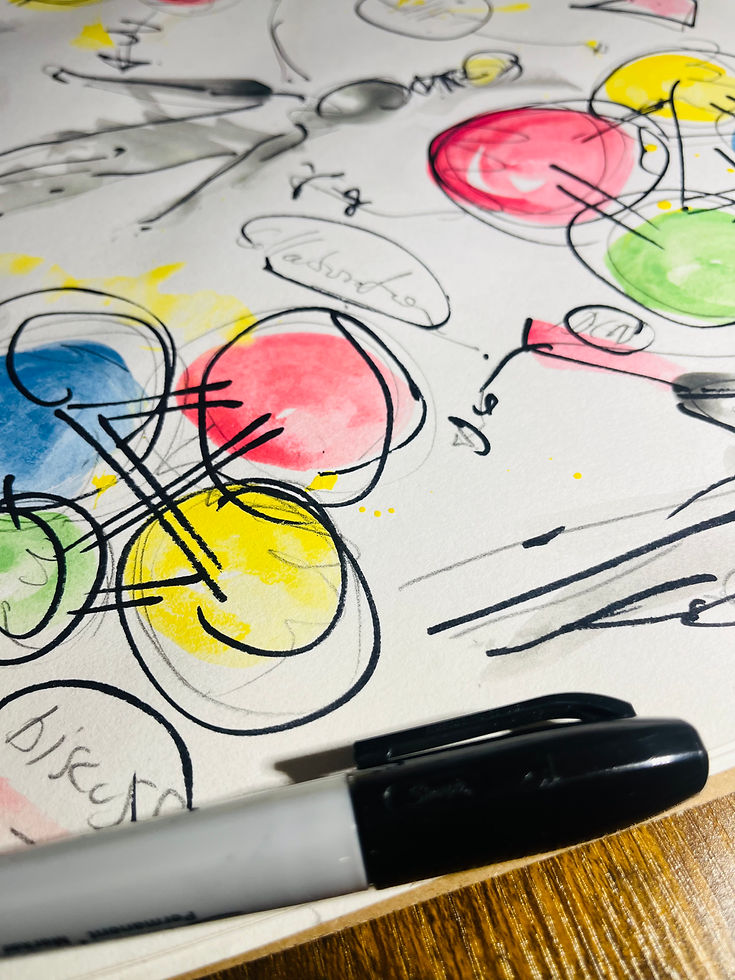
When I try to visualise this process, it often looks something like a simple network of connections…ideas moving between people, intersecting, reshaping and reconnecting in new ways.

In my own creative practice I see a similar effect when working across different mediums. Moving between collage, sketching, photography, writing and different materials changes the behaviour of ideas. Something that feels heavy or fixed in one medium can become lighter and more fluid in another. The shift in process encourages ideas to stretch and reorganise themselves.
The same principle applies when people from different backgrounds, disciplines and ways of thinking come into contact with one another. Ideas begin to migrate. They expand slightly beyond their original boundaries and adapt in response to new influences.
This is not really about networking in the conventional sense, nor about expanding contacts for its own sake. It is about exposure to difference. Creative thinking thrives when it encounters variety. It needs a certain degree of friction…not conflict, but contrast. The right kind of connection does not overwhelm an idea; it energises it and reveals possibilities that were previously hidden.
In both creative and consultancy environments, some of the most meaningful shifts rarely emerge from structured strategy sessions alone. They appear in unexpected conversations, when someone slightly outside the usual frame asks a question that reframes the discussion entirely.
Those moments may seem small at the time, but they often mark the point where familiar ideas begin to quietly redraw themselves.


Comments